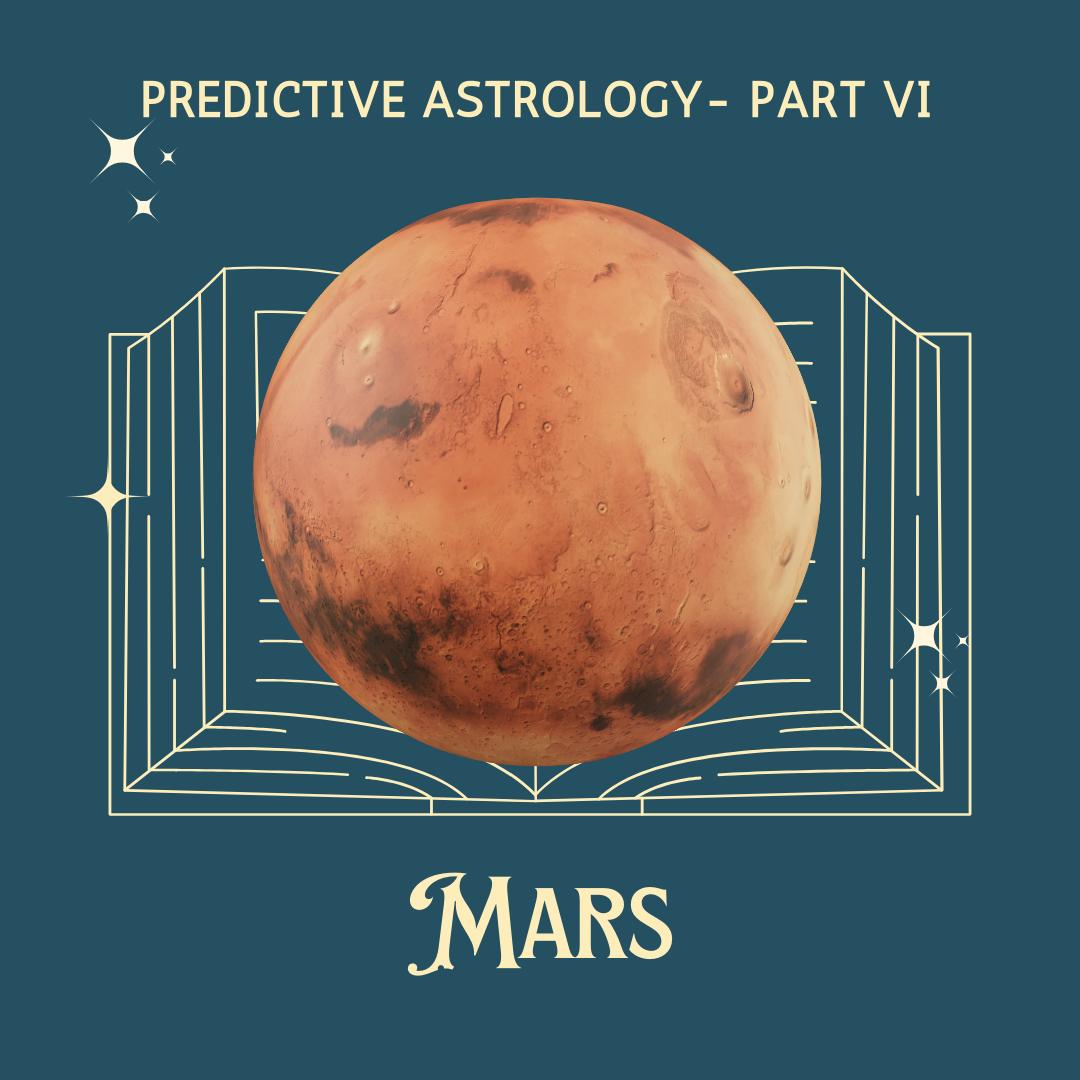
The sixth volume in the Predictive Astrology series explores an in-depth study of the characteristics, strengths, weaknesses, and other significations of the planet Mars.
Mars:
Mars is known as the Warrior among the planets. The planet is also known as Mangal, meaning “auspicious.” In the sacred texts, Mars is adorned with many powerful names: Raktavarna — the one whose hue is like blood; Bhauma — the son of Bhumi (Mother Earth); Lohitanga — the red-bodied or iron-bodied one; Kuja — born of the Earth; Bha — the shining one; and Angaraka — the radiant and fiery force.
A strong Mars—when placed in its own signs Mesha (Aries) or Vrischika (Scorpio), exalted in Makara (Capricorn), or when conjunct or aspected by benefic planets such as Jupiter or the Sun—bestows an adventurous and independent spirit. It grants generosity, ambition, integrity, courage, dynamism, and leadership. Such natives are natural administrators, charitable in action, dominant yet protective.
Those influenced by a powerful Mars are drawn to forests, wild animals, archaeology, secret services, and professions involving weapons or sharp instruments—this also includes surgeons and medical doctors. They may excel as goldsmiths, farmers, athletes, or skilled archers. Speed thrills them; they enjoy fast driving and daring adventures. They are supportive of their siblings and often prefer spicy, oily, and pungent foods. A fondness for earthenware, red objects, flashy or high-speed vehicles, and the ownership of land is commonly seen.
A weak or afflicted Mars—when placed in its debilitated sign Karkataka (Cancer), or when conjunct or aspected by malefic planets such as Saturn, Mercury, Rahu, or Ketu—can manifest as aggression, uncontrolled anger, and reckless risk-taking. It may produce cruelty, a tendency to hold grudges, impulsiveness, adulterous behavior, and quarrelsome tendencies. Such individuals may be headstrong, unruly, fickle-minded, and prone to accidents, burns, insect bites, cuts, and wounds. A preference for non-vegetarian food and strong drinks may arise, with possible addiction to alcohol.
Physical attributes governed by Mars often include fierce or reddish eyes, a wheatish complexion, a youthful yet rugged appearance, medium to tall stature, a muscular build, acne-prone skin, short or curly hair, and a lean waist. The native radiates valor, vitality, and excitability.
Body parts ruled by Mars include the forehead, left ear, nose, muscular system, external reproductive organs, blood vessels, uterus, kidneys, prostate gland, groin, rectum, colon, testicles, and red bone marrow.
Diseases signified by Mars are typically acute in nature: fevers, inflammation, smallpox, burns, measles, boils, ruptured blood vessels, fistulas, hemorrhages, hernia, miscarriages, appendicitis, sunstroke, and muscular rheumatism.
Mars also signifies fierce creatures of the wild—tiger, wolf, and hunting dog—as well as predatory birds such as the hawk, kite, and vulture, all embodying its raw, untamed, and fiery essence.
Facts about Planet Mars:
Deity: Lord Hanuman
Element: Water
Rasi(zodiac sign): Mesha(Aries) & Vrischika(Scorpio)
Caste: Kshatriya
Color: Red
Day: Tuesday
Body part: Blood, Muscles
Gem: Red Coral
Metal: Copper
Taste: Bitter
Family: Brother (siblings)
Season: Summer(Grishma Ritu) June-July
Element: Fire
Places: Fire place
Gender: Male
Direction: South
Aspects: 4th,7th & 8th house
Basic nature: Tamasic
Exaltation: Makara(Capricorn)
Debilitation: Karkatakam(Cancer)
Friendly planets: Sun & Jupiter
Neutral planet: Moon
Enemy planets: Saturn, Mercury, Rahu & Ketu
Transit time : 45 days
Remedies for Mars:
1. Pray to Lord Hanuman on Tuesdays.
2. Pray to Lord Subrahmanya on Tuesdays
3. Take care of your sibling.
4. Do fasting on Tuesdays and avoid eating salt on Tuesdays.
5. Donate food to the needy on Tuesdays
6. Feed monkeys or cows.
7. The items that can be donated on a Tuesday for weak Mars are – red masoor dal, red cloth, red coral, jiggery and copper.
Mythology:
Mangal, also known as Kuja or Bhauma, is said to have been born from the sacred sweat of Lord Shiva, emerging through the womb of Mother Earth. The Puranic lore preserves two profound and fiery legends describing his birth.
1. The Slaying of Andhakasura
Once, the mighty Asura Andhakasura performed intense tapasya to appease Lord Shiva. Pleased with his devotion, Shiva granted him a formidable boon: from every drop of his blood that touched the Earth, a new Andhakasura would arise, making him nearly invincible. Empowered by this gift, Andhakasura grew arrogant and unleashed destruction upon the worlds. The Earth turned crimson with his blood, and creation trembled in chaos.
The devas and sages sought refuge in Shiva, and a fierce cosmic battle ensued. As the conflict raged and existence itself seemed to waver, Shiva paused briefly in deep contemplation. In that moment of intense focus and divine strain, he shook his head in despair, and beads of sweat fell from his forehead onto the blood-soaked Earth.
From that sacred union of Shiva’s fiery essence and the wounded Earth arose a radiant, red-hued being — Mangal. Born of battle, he carried within him the vibrations of anger, courage, and relentless force. Yet, as the son of Bhumi (Earth), he also embodied humility, endurance, and the power to absorb negativity.
Mangal immediately joined Shiva in the battle. With divine resolve, he absorbed every drop of Andhakasura’s blood before it could touch the ground, thus halting the demon’s endless replication. Deprived of his boon’s protection, Andhakasura was finally slain.
Pleased with Mangal’s valor and unwavering support, Shiva granted him a celestial abode, placing him in the heavens as the glowing planet Mars in the cosmic expanse of the Milky Way.
2. The Wrath Following Sati’s Death
Another legend connects Mangal’s birth to Shiva’s boundless grief and rage after the self-immolation of his beloved wife, Sati. Overcome with sorrow and fury toward Daksha, Shiva prepared to unleash his vengeance. As he bent to lift Sati’s lifeless body, beads of sweat formed upon his brow — heated by grief and cosmic anger.
When these fiery drops fell upon the Earth, they scorched her surface. From this searing contact, Mother Earth brought forth a blazing, radiant child — Mangal, glowing like molten fire.
Consumed by wrath, Shiva commanded Mangal to assist in the destruction of the worlds as he performed the terrible Tandava, the dance of dissolution. Flames engulfed creation, and the universe trembled beneath their combined fury. Yet, as destruction reached its peak, both Shiva and Mangal gradually calmed. From devastation emerged stillness.
Recognizing Mangal’s immense power and loyalty, Shiva granted him a permanent place among the celestial bodies, installing him in the heavens as the fiery planet Mars — a symbol of strength, passion, warfare, and transformative force.
Thus, in both legends, Mangal is born of Shiva’s intense emotion — whether battle-strain or grief-stricken rage — yet tempered by the grounding grace of Mother Earth, making him both destroyer and protector, warrior and stabilizer in the cosmic order.