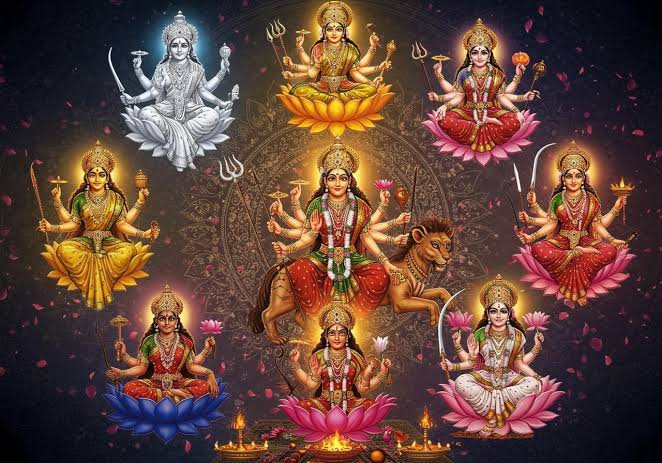
For a spiritual seeker, a Sadhaka, Navaratri is much more than just a seasonal festival or a set of rituals. It is a carefully planned nine-night journey. Its purpose is to help us rise above our lower habits, awaken our hidden spiritual energy, and connect directly with Supreme Consciousness.
To get the true benefit of this holy time, we need to look beyond the stories and understand the deeper spiritual meaning hidden inside the words, nights, and deities.
1. Meaning of the word "Navaratri"
The word Navaratri comes from two Sanskrit words:
- Nava: Has two meanings—"Nine" representing nine cosmic elements and "New" meaning rebirth or a fresh start.
- Ratri: Comes from the root word Rā, which means "that which gives rest or peace."
While daytime (dina) is filled with outward work and sensory distractions, night time (ratri) naturally encourages us to turn inward, rest, and reflect. Night is the best time for spiritual practice (sadhana) because when the outer world calms down, our subtle inner energy becomes active.
Therefore, Navaratri simply means "nine nights of deep inner renewal or travel."
2. The Deeper Meaning: The 3 Stages of Inner Growth
The nine nights are split into three sets of three days. Each set is guided by a form of the Divine Mother (Shakti). This step-by-step process helps clean our mind and energy channels by overcoming the three qualities of nature (Guna):
Days 1–3: Goddess Durga (Cleaning the Mind & Removing Bad Habits)
- Main Role: Destroying darkness, ego, and negative tendencies.
- The Inner Process: You cannot build a clean house on a dirty foundation. The first three nights are all about self-purification. Goddess Durga represents the power of action (Kriya Shakti). She fights our internal inner demons:
- Mahishasura: The demon of laziness, ignorance, and stubbornness.
- Chanda and Munda: Spiritual pride and jealousy.
- Raktabija: Uncontrolled cravings—where every single desire that drops into the mind quickly turns into a hundred more.
- Practice Focus: Fasting, self-control, discipline, and clearing old negative habits.
Days 4–6: Goddess Lakshmi (Building Good Qualities)
- Main Role: Bringing inner spiritual wealth and positive energy.
- The Inner Process: Once the mind is cleared of bad habits, it must be filled with good virtues. Goddess Lakshmi is not just about money; she represents divine willpower (Iccha Shakti) and inner wealth: kindness, peace, devotion, truth, and forgiveness.
- Practice Focus: Devotional prayer, helping others without selfish motives (Seva), and turning restless energy into pure love for God.
Days 7–9: Goddess Saraswati (Gaining True Wisdom)
- The Inner Process: When the mind is clean and filled with goodness, it becomes quiet enough to understand higher spiritual truth (Atma-Jnana). Goddess Saraswati represents pure wisdom (Jnana Shakti).
- Her instrument, the Veena, shows a well-tuned and balanced mind.
- Her vehicle, the Swan (Hamsa), represents clear judgment—the ability to separate truth from lie, just as a swan separates milk from water.
- Practice Focus: Reading holy books (Svadhyaya), deep quiet thinking, and silent meditation.
3. The Nine Forms of Durga (Navadurga) as Stages of Inner Energy Awakening
The nine forms of Durga worshiped one after another represent the step-by-step awakening of our spiritual energy Kundalini Shakti.
|
Night |
Goddess |
Simple Meaning for the Seeker |
|
1 |
Shailaputri |
Unshakable stability and strong decision. |
|
2 |
Brahmacharini |
Self-discipline, patience, and focus. |
|
3 |
Chandraghanta |
Awakening of inner awareness; a peaceful mind. |
|
4 |
Kushmanda |
Creating positive life-energy within. |
|
5 |
Skandamata |
Caring for the growing spiritual light inside. |
|
6 |
Katyayani |
Strong courage to destroy remaining ego. |
|
7 |
Kalaratri |
Overcoming fear and letting go of worldly limits. |
|
8 |
Mahagauri |
Complete purity and clear consciousness. |
|
9 |
Siddhidatri |
Reaching spiritual completion, joy, and peace. |
4. Meaning of Dasara / Vijayadashami
The 10th day, Vijayadashami or Dasara, is the final celebration of victory.
Word Meanings
1. Dasha-Hara: Means "Removing the Ten."
o Outer Story: Lord Rama defeating Ravana(ten headed asura), or Goddess Durga defeating Mahishasura.
o Inner Meaning: Defeating our 10 inner obstacles connected to the 10 senses (Jnanendriyas or 5 organs of perception, and Karmendriyas or 5 organs of action). These 10 obstacles are:
Lust (Uncontrolled desires)
Anger
Greed
Attachment
Pride/Arrogance
Jealousy
Restless Mind (Chitta / Unsettled thought-waves)
Distorted Intellect (Reasoning driven by pride and bias)
False Ego (Ahamkara / Identification with the material self)
Deep Past Conditioning (Samskaras)
2. Vijaya-Dashami: Means "Victory on the Tenth Day."
o The number 10 stands for perfection and completion.
o It represents reaching the highest state of peace (Turiya) beyond waking, dreaming, and deep sleep. On this day, the seeker achieves complete spiritual success and lasting inner peace